Bad switch
August 14, 2026
I have a good example of a bad design. In the quest to make products cheaper, something has to give – and my recent experience with the control switch for our evaporative (“swamp”) cooler provides an illustrative example.
The cooler started misbehaving, but not in a super obvious way. It’s a simple machine - a water pump and a 2-speed motor to drive the blower and controlled by a six-position switch. Something seemed wrong in the “High Cool” mode, the fan motor didn’t sound right and not enough air was coming out, but otherwise it was working OK. The motor eventually died, and after I replaced it, the symptoms continued, so I started checking out the switch.
Mind you, I didn’t think to start with the switch! I checked every other possible thing first (of course) – the wiring, the motor, the wiring again… then the switch, connected to the motor (which gave spurious readings) and only at the end did I finally look at the switch, disconnected from the circuit.
We don’t have anything more than a rudimentary switch on this cooler; the basic setup is totally 1960s (when the house was built.)
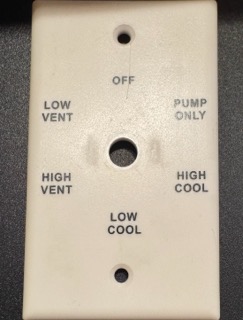
The switch plate lists the six possible positions; the back of the switch module has four connections, the bottom left is the hot input, and the three top positions correspond to the low fan output, pump output, and high fan output (labeled 1, 2 and C).
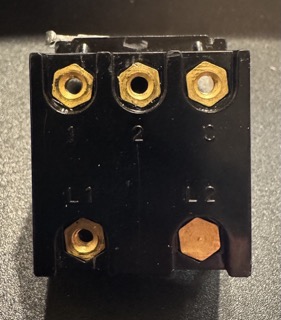
The table below shows how it should function, and how it actually was working – definitely not right, and it explains why the motor was having issues in the High Cool mode! Sending power to both high- and low-speed motor windings means they end up fighting each other; bad for the motor. A previously-unnoticed issue also showed up: the water pump was running when it shouldn’t, in the “Low Vent” setting – I didn’t see it before, as I almost always ran the cooler in “Low Cool”.
Truth table: nominal (as-found)
| State | 1 (low) | 2 (pump) | C (high) |
|---|---|---|---|
| OFF | 0 | 0 | 0 |
| PUMP ONLY | 0 | 1 | 0 |
| HIGH COOL | 0 (1) | 1 | 1 |
| LOW COOL | 1 | 1 | 0 |
| HIGH VENT | 0 | 0 | 1 |
| LOW VENT | 1 | 0 (1) | 0 |
I bought a new (identical) switch for $16 and it checked out fine. That left me very curious as to why the old switch was failing in this way – was a circuit board fried, or what?
Disassembling the switch module revealed how it works: there’s a rotary cam, which presses on little tabs that break electrical contacts. There are four of these switches, each one corresponding to a position on the cam. It is not intended to be serviceable in any way.
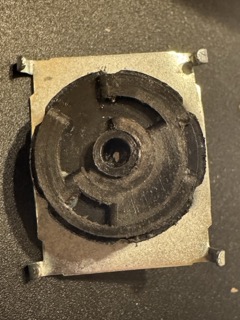
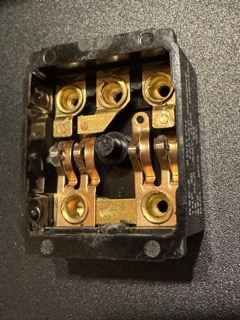
The cam positions, from innermost to outermost, correspond to the switches from left to right, according to this table:
Table of correspondence between cam positions, switches, and outputs
| Output | 1 (low) | 2 (pump) | C (high) |
|---|---|---|---|
| Switch (L to R) | 4 | 2 | 1 |
| Cam position (inner to outer) | D | B | C |
Note that the inner-most cam position (A) doesn’t actually do anything, in this module – it corresponds to switch 3, which isn’t connected to an output.
I checked the outputs against the truth table by eye, and everything matched up correctly; so there’s no defect in the “logic” of the device, and there must be something else going on. It took me a while, looking at the thing and playing around with it while checking continuity in each setting with a multimeter, but I did eventually figure it out. The cam has worn down just a little, but enough that it doesn’t fully push in the switch tabs to open up the electrical connections, in those two bad positions. It’s barely noticeable when looking at the cam, you have to feel it with a fingernail, and even then it’s quite subtle.
But that’s a terrible design! When it wears, which it will, the degradation causes serious electrical issues that would not be expected, and could damage the motor. I’d love to see some version of this module from say 20 years ago…
When this module starts to show signs of wear, I’m going to replace it with something more robust, simpler, and serviceable: a pair of toggle switches!

Or, perhaps, I’ll just buy the latest greatest electronic confabulation (from a local small woman-owned outfit in Albuquerque) and have a different set of issues to contend with…