LoRa mesh radios
March 21, 2026
I’m a long time advocate of LoRa radio technology. It has some very attractive features if you want to move small amounts of data a long way on very little power. After playing with it a bit when it first came on the market, I’ve mostly been watching it since, as I didn’t have my own use-case at hand. But now I do! I wanted a backup communications system for when we’re out in the remote areas of the US west, with poor or no cell coverage. While my iPhone has satellite capability, it will only work when there’s no cell service at all – if the phone thinks it has one measly bar of service, the sat comm option won’t come up, but the phone might not be able to even get a text message out. Additionally, my wife’s phone is older; no satellite capability for her. “Aha!” I thought, “LoRa would be an excellent solution!”
Alongside the IoT-focused LoRaWAN, two other open meshes have emerged: Meshtastic and MeshCore. They each have their pros and cons, but they both would check the box for what I want. A little serching and I found quite a few pre-packaged and DIY options for combining a LoRa radio, microcontroller, bluethooth, battery, and antenna in a compact and rugged box.
I opted to get two of the Elecrow ThinkNode M1 radios, as they have a small eInk display, a couple buttons, and a GPS module with an external switch, all in an injection-molded case. Very nice! These features mean that, at least for the Meshtastic firmware, you can use the radio stand-alone; the more typical use-case is to have your phone paired with it over Bluetooth, but with the little display, you can select from a set of pre-defined messages to send, and read received messages. The UI is still pretty limited, but it does work.
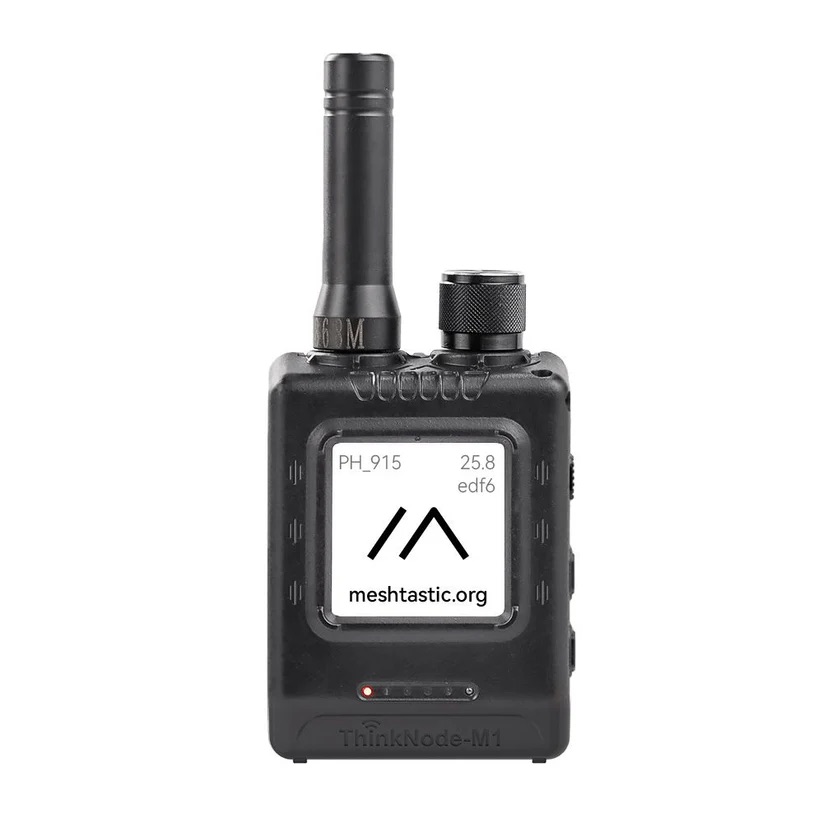
On the MeshCore firmware, though, you really must treat it as a companion device to your phone, tablet, laptop, or whatever; the display only shows some status and lets you toggle bluetooth on/off.
I got longer antennas for the radios, in addition to their default stubby antennas. With the long ones, I’m getting better than 50 mile range! Going through the local repeaters, I’ve hit nodes more than 100 miles out. Even the stubbies are pretty good, I can hit two local repeaters that are about 15 miles away.