Articles
-
Christmas project
January 4, 2010
Read moreI made a little project for some friends and relatives this Christmas… using an Arduino microcontroller board, an Altoids tin, and some assorted bits, I built a simple interface to a virtual Etch-a-Sketch (written in Processing). Two knobs control the up-down and left-right drawing of a line on the computer screen; a pushbutton changes the color of the line being drawn; a toggle switch changes between keeping the line continuously on the screen, and fading out the tail as the head of the line is being drawn. Just like a real Etch-a-Sketch, shaking the box erases the screen (using a tilt-switch inside the tin.)
Isn't it cute? 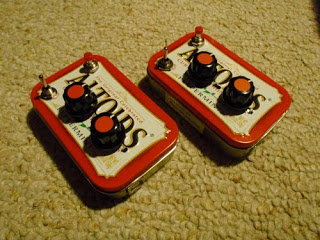
-
Puffy
December 3, 2009
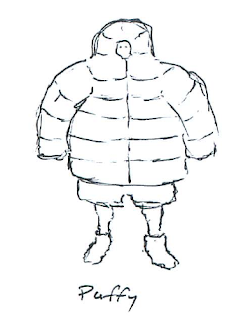
I saw this guy at Washington Dulles airport, and felt compelled to make a sketch…
-
Google imitates life
November 17, 2009
It’s interesting to note what Google’s AdWords serves up on Joe Papp’s blog post about what doping (or more precisely, getting caught) did to his cycling career and life:

-
Big Pants
September 21, 2009
Well, pretty much everyone in the Red States and quite a few of those in the Blue will loathe me for complaining about this, but: All my pants are now too big in the waist by at least an inch, and sometimes two. It’s not like I ever had much weight to lose, mind you – but all the riding this summer has melted off what little I had accumulated around the middle, leaving me (a) hungry, and (b) looking for belts. Time to clean out the closet, I suppose.
-
Bike design
August 7, 2009
Read moreAccording to the annals of cycling lore, a great bike should:
- “Disappear” beneath the rider
- Feel fast
- Not absorb the rider’s energy
These are all highly subjective, qualitative descriptions… but anyone who has ridden a bike that can be described this way, remembers the experience. What are some of the contributing factors that make such a bike?
